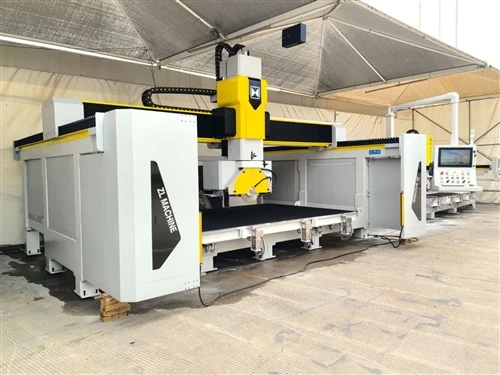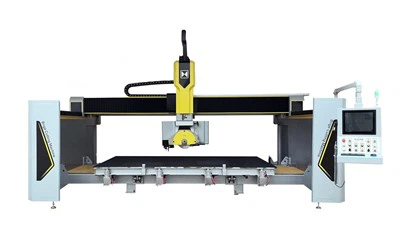
In the modern manufacturing landscape, the pursuit of enhanced productivity is a constant endeavor. Among the various technological advancements that have revolutionized the industry, the 5 Axis CNC Saw stands out as a game - changer. As a leading supplier of 5 Axis CNC Saws, I have witnessed firsthand how this remarkable machine can significantly boost productivity across multiple sectors.
Precision and Flexibility
One of the primary ways a 5 Axis CNC Saw improves productivity is through its unparalleled precision and flexibility. Traditional saws are often limited to two or three axes of movement, which restricts the complexity of cuts that can be made. In contrast, a 5 Axis CNC Saw can move along five different axes simultaneously. This allows for the creation of intricate and complex shapes with a high degree of accuracy.


For example, in the stone - cutting industry, where the demand for custom - designed products is on the rise, a 5 Axis CNC Saw can precisely cut stones into various shapes, such as curves, angles, and bevels. The ability to make such precise cuts reduces the need for secondary finishing operations. Workers no longer have to spend hours manually adjusting and refining the cuts, which would otherwise be necessary with less sophisticated equipment. This reduction in post - processing time directly translates into increased productivity.
Moreover, the flexibility of a 5 Axis CNC Saw means that it can handle a wide variety of materials and workpiece sizes. Whether it's cutting through thick metal sheets, delicate plastics, or dense woods, the machine can adapt its cutting parameters accordingly. This versatility eliminates the need for multiple saws for different materials, streamlining the manufacturing process and reducing the time spent on equipment change - overs.
Automation and Efficiency
Automation is a key feature of 5 Axis CNC Saws, and it is one of the most significant factors contributing to improved productivity. These machines are programmed using advanced CAD/CAM software, which allows operators to design the cutting path in a virtual environment before the actual cutting process begins. Once the program is loaded into the machine, the 5 Axis CNC Saw can perform the cutting operations automatically, with minimal human intervention.
The automation of the cutting process reduces the risk of human error, which can lead to costly mistakes and rework. For example, in a production line where parts need to be cut with the same specifications repeatedly, a CNC - controlled system ensures that each piece is cut with the exact same level of precision. This consistency not only improves the quality of the final products but also accelerates the production speed.
Additionally, 5 Axis CNC Saws often come with features such as automatic material loading and unloading systems. These systems can continuously feed new materials into the machine and remove the finished parts, minimizing the downtime between cuts. In a large - scale manufacturing setting, this continuous operation can lead to a significant increase in the overall production output.
Integration with Existing Systems
Another advantage of 5 Axis CNC Saws is their ability to integrate seamlessly with existing manufacturing systems. For companies that have already invested in other CNC machines or production lines, a 5 Axis CNC Saw can be incorporated into the existing workflow without major disruptions.
This integration allows for better coordination between different processes. For instance, in a metal - fabrication plant, a 5 Axis CNC Saw can be connected to a CNC milling machine and a CNC lathe through a manufacturing execution system (MES). This enables real - time data sharing and synchronization between the machines. The cut parts from the saw can be automatically transferred to the next machine in the production line, reducing the time spent on manual handling and transportation.
Furthermore, the data collected from the 5 Axis CNC Saw during the cutting process can be used for quality control and process optimization. By analyzing factors such as cutting speed, feed rate, and tool wear, manufacturers can make adjustments to improve the efficiency of the entire production process. This data - driven approach to manufacturing helps in identifying bottlenecks and areas for improvement, leading to increased productivity in the long run.
Cost - Effectiveness
Although the initial investment in a 5 Axis CNC Saw may be relatively high, it offers long - term cost - effectiveness, which is closely related to increased productivity. Firstly, the high precision and low rate of error in cutting operations mean that there is less material waste. In industries where raw materials are expensive, such as the aerospace or jewelry sectors, reducing material waste can lead to substantial cost savings.
Secondly, as mentioned earlier, the automation and reduced need for manual labor result in lower labor costs. With a 5 Axis CNC Saw, one operator can oversee multiple cutting operations simultaneously, and the machine can run continuously throughout the day with minimal supervision. This allows manufacturers to reallocate their human resources to more value - added tasks, such as product design and quality control.
In addition, the durability and reliability of 5 Axis CNC Saws contribute to cost savings. These machines are built to last, with high - quality components and advanced engineering. They require less frequent maintenance and have a lower risk of breakdowns compared to traditional saws. This means less downtime for repairs and maintenance, which directly impacts productivity.
Productivity in Different Industries
Stone Cutting Industry
In the stone cutting industry, the 5 Axis CNC Saw has revolutionized the way products are made. It can create a wide range of stone products, from simple countertops to highly complex sculptures. The precision of the 5 Axis CNC Saw allows for detailed carving and shaping of stones, which was previously only possible through time - consuming and labor - intensive manual methods.
With the help of the CNC Water Retaining Strip Cutting Machine, the 5 Axis CNC Saw can accurately cut water - retaining strips in stone slabs, which are commonly used in outdoor landscaping and architecture. The Bridge Stone Cutting Machine can also be integrated with the 5 Axis CNC Saw to provide a more comprehensive stone - cutting solution, improving the overall productivity of the stone - processing workshop.
Metalworking Industry
In the metalworking industry, the 5 Axis CNC Saw is used for cutting various metal components, such as automotive parts, aerospace components, and industrial machinery parts. The ability to make complex cuts allows manufacturers to produce high - quality parts with tight tolerances. The CNC Machine Stone Cutting technology, although mainly associated with stone, shares some similarities with metal - cutting in terms of precision control. This cross - industry technology adoption can inspire further innovation in metal - cutting processes using 5 Axis CNC Saws.
The high - speed cutting capabilities of 5 Axis CNC Saws in the metalworking industry mean that large - scale production can be completed much faster. For example, in the automotive manufacturing sector, the time taken to cut engine blocks or frame components can be significantly reduced, leading to an increase in the production volume of cars.
Woodworking Industry
In woodworking, the 5 Axis CNC Saw enables the creation of intricate furniture designs and decorative elements. It can cut through different types of wood, including hardwoods and softwoods, with ease. The precision cutting ensures that the joints between wood pieces fit perfectly, eliminating the need for further adjustment. This improves the overall quality of wood products and speeds up the assembly process.
In addition, the flexibility of the 5 Axis CNC Saw allows woodworkers to experiment with new designs and shapes, which can open up new market opportunities. The ability to quickly switch between different cutting programs means that small - batch production of customized wood products can be carried out efficiently, meeting the growing demand for personalized items.
The Future of Productivity with 5 Axis CNC Saws
As technology continues to evolve, the productivity potential of 5 Axis CNC Saws is only set to increase. Advancements in software algorithms will further enhance the precision and speed of the cutting process. Real - time monitoring and predictive maintenance systems will be more commonly integrated into these machines, reducing the risk of unexpected breakdowns and optimizing performance.
The combination of 5 Axis CNC Saws with emerging technologies such as artificial intelligence and the Internet of Things (IoT) will also create new possibilities. AI - powered algorithms can analyze cutting data in real - time to make automatic adjustments to the cutting parameters, further improving efficiency. IoT connectivity will enable seamless communication between machines, allowing for more coordinated and efficient production processes.
Conclusion
In conclusion, a 5 Axis CNC Saw is a powerful tool that can significantly improve productivity in various industries. Its precision, flexibility, automation, and cost - effectiveness make it an indispensable asset for modern manufacturing. By reducing production time, minimizing material waste, and integrating with existing systems, a 5 Axis CNC Saw offers a competitive edge to businesses in today's fast - paced market.
If you're looking to enhance the productivity of your manufacturing operations, we invite you to explore our range of 5 Axis CNC Saws. Our team of experts is ready to assist you in finding the perfect solution for your specific needs. Contact us today to start a conversation about how we can help you elevate your production capacity and achieve greater success.
References
- Groover, M. P. (2019). Fundamentals of Modern Manufacturing: Materials, Processes, and Systems. Wiley.
- Dornfeld, D. A., Min, S., & Takeuchi, Y. (Eds.). (2018). Handbook of Machining with Grinding Wheels. Springer.
- Chakraborty, S., Shokrani, A., Dhokia, V., & Newman, S. T. (2017). The current state of machining in Industry 4.0. Procedia CIRP, 62, 203 - 208.