How were stone tools made in prehistoric times?
In the vast expanse of prehistoric times, the creation of stone tools was a revolutionary development that significantly shaped the course of human evolution. These tools were not only essential for survival but also marked a crucial step in the cognitive and technological advancement of early humans. As a stone tool supplier, understanding the ancient techniques of stone tool production provides valuable insights into the craftsmanship and innovation of our ancestors, which in turn informs our modern - day approach to stonework.
The Early Stages: Simple Stone Flaking
The earliest stone tools date back over 2.6 million years and were primarily made through a process known as percussion flaking. Early hominids, such as Australopithecus and later Homo habilis, selected suitable stones, often river pebbles or cobbles, which were relatively hard and had a fine - grained texture. These stones were usually made of materials like chert, flint, or obsidian, which could break in a predictable manner.
The basic method involved taking a hammerstone, typically a hard, rounded rock, and striking the core stone at an angle. The force of the impact would cause flakes to break off from the core. These flakes were often sharp - edged and could be used immediately for cutting, scraping, or piercing. The core itself could also be shaped further and used as a tool, for example, as a chopper for breaking bones or cutting through tough plant materials.
This simple form of flaking was a significant achievement as it allowed early humans to create tools from readily available natural resources. It required an understanding of the properties of different stones and the ability to control the force and angle of the strike to produce useful flakes.
The Acheulean Tradition: Advanced Bifacial Tools
Around 1.76 million years ago, a more sophisticated stone - tool - making tradition emerged, known as the Acheulean. This period was characterized by the production of bifacial tools, such as handaxes. These tools were carefully shaped on both sides, creating a symmetrical and more refined form.
To make a handaxe, the craftsman would start with a large core and use a series of carefully planned strikes to remove flakes from both surfaces. This process required a high level of skill and patience. The goal was to create a tool with a sharp edge all around and a comfortable grip. Handaxes were versatile tools that could be used for a variety of tasks, including butchering animals, cutting wood, and even as a weapon in some cases.
The Acheulean tradition represented a significant leap in cognitive development. It demonstrated that early humans had the ability to visualize the final form of the tool and plan the manufacturing process accordingly. This was a far cry from the simple flaking techniques of earlier times and showed a growing understanding of the potential of stone as a material for tool - making.
Middle Paleolithic: Levallois Technique
During the Middle Paleolithic period, approximately 300,000 to 30,000 years ago, a revolutionary stone - tool - making technique called the Levallois technique was developed. This method involved preparing the core in a specific way before removing the desired flake.
First, the core was shaped into a particular form, often with a convex surface on one side and a flat or slightly concave surface on the other. The edges of the core were carefully trimmed to create a striking platform. When a strike was made on the striking platform, a large, pre - determined flake would break off with a sharp edge and a relatively regular shape.
The Levallois technique was highly efficient as it allowed the craftsman to produce large, standardized flakes with minimal waste. These flakes could be further modified into a variety of tools, such as scrapers, points, and knives. This technique also required a deep understanding of the fracture mechanics of stones and the ability to plan the entire manufacturing process in advance.
Neolithic Revolution: Polished Stone Tools
The Neolithic period, starting around 10,000 BC, brought about another significant change in stone - tool - making. With the advent of agriculture and settled communities, there was a need for more specialized tools. This led to the development of polished stone tools.
To make polished stone tools, the initial step was similar to the earlier techniques: the stone was first shaped by flaking to get the basic form. However, after the rough shaping, the tool was then ground and polished. This was done by rubbing the tool against a coarse stone to smooth out the surface and then using a finer - grained stone or abrasive material to create a polished finish.
Polished stone axes were one of the most important tools of this period. They were much stronger and more durable than their flaked counterparts. The polished surface reduced friction, making it easier to cut through wood, which was essential for building shelters, making agricultural implements, and clearing land for farming.
Modern Stone - Tool - Making Techniques
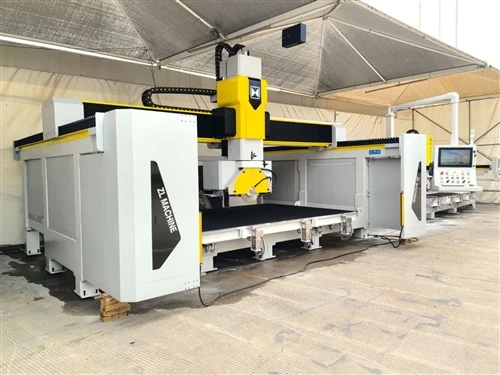
Today, as a stone tool supplier, we have access to advanced technology that has revolutionized the stone - working industry. Granite CNC Router is one such example. These machines use computer - numerical - control (CNC) technology to precisely cut and shape granite and other stones. They can create complex designs and patterns with a high degree of accuracy, which was impossible to achieve in prehistoric times.
Another important modern machine is the Stone Chamfer Edge Polisher Machine. This machine is designed to polish the edges of stones, giving them a smooth and finished look. It is particularly useful for creating decorative stone pieces or for finishing the edges of countertops and other architectural elements.
The Cnc Stone Cutting And Polishing Machine For Quartz is also a valuable asset in our modern stone - tool - making process. It can cut and polish quartz stones with great precision, allowing us to produce high - quality quartz products for various applications.
Conclusion and Call to Action
The journey of stone - tool making from prehistoric times to the present day is a testament to human ingenuity and the continuous pursuit of innovation. From the simple flaking techniques of our early ancestors to the advanced CNC machines of today, the art of working with stone has evolved significantly.
As a stone tool supplier, we are committed to carrying on this rich tradition of craftsmanship while leveraging modern technology to provide high - quality stone tools and products. Whether you are in the construction industry, the art and sculpture field, or simply looking for unique stone pieces for your home, we have the expertise and resources to meet your needs.


If you are interested in our stone tools or have specific requirements, we invite you to contact us for a procurement discussion. We look forward to working with you to bring your stone - related projects to life.
References
- Klein, R. G., & Edgar, B. (2002). The Dawn of Human Culture. Wiley.
- Schick, K. D., & Toth, N. (1993). Making Silent Stones Speak: Human Evolution and the Dawn of Technology. Simon & Schuster.
- Wynn, T., & Coolidge, F. L. (2011). How to Think Like a Neandertal. Oxford University Press.