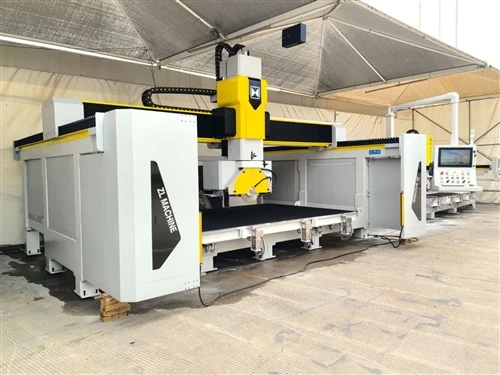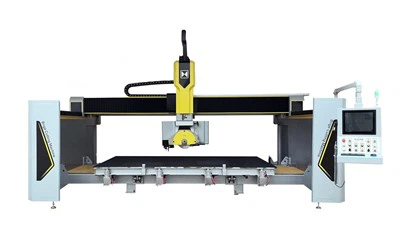
Hey there! As a supplier of Granite Bridge Saws, I often get asked about the cutting smoothness of these machines. So, I thought I'd take a moment to break it down for you.
First off, what exactly is cutting smoothness? Well, in the context of a Granite Bridge Saw, it refers to how evenly and cleanly the saw blade cuts through the granite. A smooth cut is crucial for a few reasons. For one, it affects the overall quality of the finished product. If the cut isn't smooth, you might end up with rough edges, chips, or uneven surfaces, which can be a big no - no, especially for high - end projects like countertops or decorative pieces.
Let's talk about the factors that contribute to the cutting smoothness of a Granite Bridge Saw.
Saw Blade Quality
The saw blade is the heart of the cutting process. A high - quality saw blade is designed to cut through granite with minimal resistance. It has sharp, evenly spaced teeth that can slice through the hard stone without causing too much vibration. When the blade is dull or of poor quality, it can't cut smoothly. You'll notice that the saw might struggle to make a clean cut, leaving behind jagged edges.
For example, a diamond - tipped saw blade is a popular choice for cutting granite. Diamonds are one of the hardest substances on Earth, and they can easily cut through the tough granite. The quality of the diamonds, their size, and how they're bonded to the blade all play a role in determining the cutting smoothness. A well - made diamond - tipped blade will glide through the granite, leaving a smooth finish.
Machine Stability
Another important factor is the stability of the Granite Bridge Saw. A stable machine reduces vibration during the cutting process. When the saw vibrates too much, it can cause the blade to move erratically, resulting in an uneven cut.
Our Granite Bridge Saw With Tilt Table is built with a sturdy frame and advanced engineering to ensure maximum stability. The frame is made of high - strength materials that can withstand the forces generated during cutting. Additionally, the saw is designed with precision guides and bearings that keep the blade in place, allowing for a smooth and accurate cut.
Feed Rate
The feed rate, which is how fast the saw moves across the granite, also impacts cutting smoothness. If the feed rate is too fast, the blade might not have enough time to cut through the stone properly, leading to a rough cut. On the other hand, if the feed rate is too slow, it can be time - consuming and might cause the blade to overheat.
Finding the right feed rate depends on several factors, such as the hardness of the granite, the type of saw blade, and the thickness of the stone. Our saws are equipped with adjustable feed rate controls, so you can fine - tune the speed to achieve the best cutting smoothness for your specific project.


Water Cooling System
Granite cutting generates a lot of heat. If the heat isn't managed properly, it can damage the saw blade and affect the cutting smoothness. That's where the water cooling system comes in.
A good water cooling system keeps the saw blade cool during the cutting process. It also helps to flush away the granite dust and debris, preventing them from interfering with the cut. Our Granite Bridge Saws come with an efficient water cooling system that ensures the blade stays at an optimal temperature, resulting in a smooth and clean cut.
Precision and Calibration
Precision is key when it comes to cutting smoothness. The saw needs to be properly calibrated to ensure that the blade is cutting at the right angle and depth. Even a small misalignment can cause the cut to be uneven.
Our CNC Stone Saw takes precision to the next level. It uses computer - numerical control technology to accurately control the movement of the saw blade. This means that you can achieve highly precise cuts, every time. The CNC system allows you to program the saw to make complex cuts with ease, and it ensures that the cutting smoothness is consistent across the entire piece of granite.
Operator Skill
Last but not least, the skill of the operator plays a role in the cutting smoothness. An experienced operator knows how to adjust the saw settings, handle the machine properly, and make any necessary adjustments during the cutting process.
We offer training and support to our customers to help them get the most out of our Granite Bridge Saws. Our team of experts can teach you the best practices for achieving optimal cutting smoothness, so you can produce high - quality finished products.
Now, let's take a look at some real - world examples of how our saws perform in terms of cutting smoothness.
One of our customers, a small - scale stone fabrication shop, was struggling to get smooth cuts on their granite countertops. They were using an old, low - quality saw that was causing a lot of problems. After switching to our Granite Cutting Bridge Saw, they noticed a significant improvement. The cuts were much smoother, and they were able to produce countertops with a professional finish. This not only improved the quality of their products but also increased their customer satisfaction and business.
In conclusion, the cutting smoothness of a Granite Bridge Saw is determined by a combination of factors, including saw blade quality, machine stability, feed rate, water cooling system, precision, and operator skill. Our saws are designed to address all these factors, ensuring that you get the best possible cutting performance.
If you're in the market for a Granite Bridge Saw and want to achieve top - notch cutting smoothness, we'd love to hear from you. Whether you're a large - scale stone fabricator or a small - business owner, we have the right saw for your needs. Contact us today to discuss your requirements and let's start a conversation about how our Granite Bridge Saws can take your cutting operations to the next level.
References
- Industry knowledge and experience in the granite cutting machinery field.
- Customer feedback and case studies from our clients using our Granite Bridge Saws.