What is the vibration level of a granite CNC router during operation?
As a supplier of Granite CNC Routers, I've received numerous inquiries about the vibration levels of these machines during operation. Understanding vibration levels is crucial as it directly affects the precision, quality of the finished product, and the overall lifespan of the equipment. In this blog, I'll delve into what vibration levels are in a granite CNC router, what factors influence them, and why maintaining optimal vibration levels is essential.
What are Vibration Levels?
Vibration levels refer to the amplitude and frequency of the oscillations that a granite CNC router experiences during its operation. These vibrations can occur in multiple directions - horizontally, vertically, and laterally. Vibration is measured in units such as millimeters per second (mm/s) for velocity, micrometers (μm) for displacement, and meters per second squared (m/s²) for acceleration.
Ideally, a granite CNC router should operate with the lowest possible vibration levels. Low vibration levels ensure that the cutting tools can move precisely, resulting in smooth cuts, accurate engravings, and high - quality finishes on the granite. High vibration levels, on the other hand, can lead to rough edges, inconsistent cuts, and premature wear of the machine's components.
Factors Influencing Vibration Levels
Machine Design and Build Quality
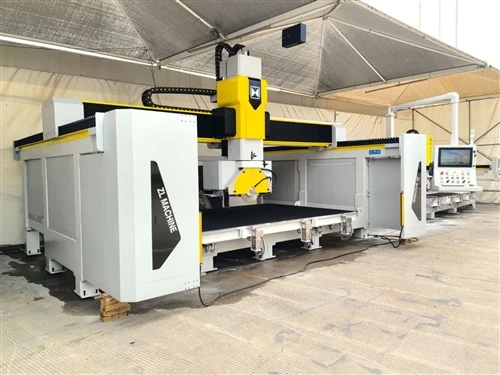
The design of a granite CNC router plays a significant role in its vibration characteristics. A well - designed machine will have a robust frame and a stable base. Our Granite Cutting CNC Machine is engineered with a heavy - duty granite base, which provides excellent stability. Granite is a dense and rigid material, which helps to dampen vibrations and prevent them from spreading throughout the machine.
Moreover, the quality of the components used in the machine also matters. High - precision linear guides, ball screws, and servo motors are less likely to introduce vibrations compared to their lower - quality counterparts. We use only top - of - the - line components in our machines to ensure minimal vibration and maximum performance.
Cutting Parameters
The cutting parameters, such as cutting speed, feed rate, and depth of cut, have a direct impact on the vibration levels. If the cutting speed is too high or the feed rate is too fast for the hardness of the granite, the cutting tool may experience excessive forces, leading to vibrations. Similarly, a large depth of cut can put more stress on the tool and the machine, causing increased vibration.
It's essential to optimize these parameters based on the type of granite and the specific cutting task. Our technical support team can assist customers in determining the ideal cutting parameters to minimize vibrations and achieve the best results.
Tool Condition
The condition of the cutting tool is another critical factor. A dull or damaged tool can cause uneven cutting forces, which in turn lead to vibrations. Regular tool inspection and replacement are necessary to maintain low vibration levels. We recommend using high - quality cutting tools that are specifically designed for granite processing. Our Headstone Engraving Machine and Granite Profiling Machine are compatible with a wide range of cutting tools, and we can provide guidance on tool selection and maintenance.
Why Optimal Vibration Levels are Important
Precision and Quality
In granite processing, precision is paramount. Whether you're creating detailed engravings on headstones or cutting intricate profiles for architectural elements, the accuracy of the cuts has a direct impact on the final product's quality. Low vibration levels ensure that the cutting tool follows the programmed path precisely, resulting in sharp edges, smooth curves, and consistent finishes.
Machine Longevity
High vibration levels can cause excessive wear and tear on the machine's components. The constant shaking can loosen screws, damage bearings, and reduce the lifespan of the linear guides and ball screws. By maintaining optimal vibration levels, you can extend the life of your granite CNC router and reduce the need for frequent repairs and replacements.
Efficiency
A machine that operates with minimal vibrations runs more efficiently. With less energy being wasted on counteracting vibrations, the router can complete tasks faster and with less power consumption. This not only reduces operating costs but also increases productivity in the long run.
Measuring and Monitoring Vibration Levels
To ensure that your granite CNC router is operating within the optimal vibration range, it's important to measure and monitor the vibration levels regularly. There are several ways to do this. Vibration sensors can be installed on the machine at key locations, such as the spindle, the cutting head, and the base. These sensors can provide real - time data on the vibration amplitude and frequency.
Some advanced granite CNC routers come with built - in vibration monitoring systems, which can alert operators when the vibration levels exceed the preset limits. This allows for immediate action to be taken, such as adjusting the cutting parameters or inspecting the tool condition.
Conclusion
As a supplier, we understand the importance of vibration levels in granite CNC routers. Our goal is to provide customers with machines that offer the lowest possible vibration levels, ensuring high - precision machining, long - lasting performance, and maximum efficiency.


If you're in the market for a granite CNC router, we invite you to contact us for a detailed discussion. Our team of experts can help you select the right machine for your specific needs, provide guidance on installation, operation, and maintenance, and answer any questions you may have about vibration levels or other technical aspects. Investing in a high - quality granite CNC router with optimal vibration characteristics is a decision that will pay off in the long term, both in terms of product quality and production efficiency. Don't hesitate to reach out and start your journey towards better granite processing today.
References
- "Machining Technology: Metal Cutting and Machine Tools" by Geoffrey Boothroyd, Peter Dewhurst, and W. Alan Knight.
- "CNC Machining Handbook" by Peter Smid.
- Industry reports on granite processing and CNC router technology.