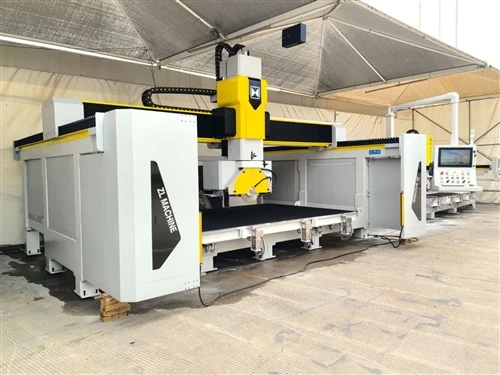
A bridge saw is a crucial piece of equipment in the stone processing industry. As a prominent bridge saw supplier, I've encountered numerous inquiries regarding the necessity of a special foundation for these machines. This exploration delves into the technical and practical aspects of whether a bridge saw truly requires a special foundation, offering insights for both novices and industry veterans.


Understanding the Bridge Saw
Before delving into the foundation requirements, it's essential to understand the nature of a bridge saw. Bridge saws are used primarily for cutting stones, including marble, granite, and other hard rocks. These machines typically consist of a bridge-like structure spanning a worktable. The cutting blade, often mounted on a movable carriage, travels along the bridge to make precise cuts on the stone placed on the table. The operation can be manual, semi - automatic, or fully automated, depending on the model.
The power and precision of bridge saws are remarkable. They can handle large slabs of stone, making them indispensable in the production of countertops, tiles, and other stone products. However, this high - performance operation comes with specific demands, especially when it comes to the machine's stability and the surface on which it operates.
The Role of a Foundation
A foundation serves as the base for any heavy machinery. Its main functions include providing support, stability, and vibration isolation. In the case of a bridge saw, a proper foundation ensures that the machine can operate smoothly and accurately.
When a bridge saw is in operation, the cutting blade exerts significant force on the stone. This force generates vibrations that can affect the machine's performance and the quality of the cut if not properly managed. A stable foundation helps to absorb these vibrations, preventing them from causing undue wear on the machine's components or affecting the accuracy of the cut.
Moreover, the foundation also needs to distribute the weight of the bridge saw evenly. Bridge saws can be quite heavy, especially larger models equipped with advanced features. An uneven distribution of weight can lead to stress concentration in certain parts of the machine, potentially causing damage over time.
Special Foundation Requirements
So, does a bridge saw require a special foundation? The answer is often yes. While smaller, less powerful bridge saws may be able to operate on a standard concrete floor in some cases, larger and more advanced models typically need a specially designed foundation.
Size and Weight Considerations
Larger bridge saws, such as the Marble Cutting Machine Big, have a greater mass. Their size and weight mean that they require a more substantial foundation to support them. A special foundation can be designed to distribute the weight of the machine more evenly, reducing the risk of floor cracking or uneven settling.
Precision and Vibration Control
For bridge saws used in high - precision operations, such as the Cnc Marble Carving Machine, a special foundation is essential. These machines rely on precise movements to create intricate cuts and patterns. Vibration can cause deviations in the cutting path, leading to imperfect results. A well - designed foundation can be engineered to dampen vibrations, ensuring that the machine can maintain the necessary level of precision.
Environmental Factors
Environmental factors also play a role in determining whether a special foundation is needed. In areas with high humidity or seismic activity, a standard floor may not be sufficient. A special foundation can be constructed to resist moisture damage and provide additional support during seismic events. For example, in earthquake - prone regions, a foundation can be designed with flexible elements to absorb the shock and prevent the machine from being damaged.
Designing a Special Foundation
If a special foundation is required for a bridge saw, several factors need to be considered during the design process.
Material Selection
The material used for the foundation is crucial. Concrete is a popular choice due to its strength and durability. Reinforced concrete, which contains steel bars or mesh, can provide even greater strength and resistance to cracking. In some cases, rubber or other vibration - absorbing materials may be incorporated into the foundation to enhance its ability to dampen vibrations.
Dimensions
The dimensions of the foundation should be carefully calculated based on the size and weight of the bridge saw. The foundation should be large enough to provide adequate support but not so large that it becomes impractical or costly. It should also be level to ensure that the machine operates correctly.
Installation Process
The installation of the foundation is as important as its design. The floor needs to be properly prepared before the foundation is poured. This may involve removing any existing debris or uneven surfaces. Once the foundation is poured, it needs to be allowed to cure properly before the bridge saw is installed.
Case Studies and Industry Insights
To illustrate the importance of a special foundation for bridge saws, let's look at some real - world examples.
In a large - scale stone processing facility, a company installed a New Granite Bridge Saw For Sale on a standard concrete floor without a special foundation. Initially, the machine seemed to operate fine. However, over time, workers noticed that the cuts were becoming less precise, and the machine was making more noise. Upon inspection, it was found that the floor had started to crack due to the uneven distribution of the machine's weight. The vibrations caused by the operation were also gradually affecting the machine's components. After installing a specially designed foundation, the problems were resolved, and the machine's performance improved significantly.
Industry experts also emphasize the importance of a proper foundation for bridge saws. They point out that investing in a special foundation can save money in the long run by reducing maintenance costs and improving the lifespan of the machine.
Conclusion
In conclusion, while not all bridge saws require a special foundation, larger and high - precision models typically do. A special foundation provides support, stability, and vibration control, which are essential for the proper operation of the machine. By considering factors such as size, weight, precision requirements, and environmental conditions, a suitable foundation can be designed and installed.
If you are in the market for a bridge saw or need advice on the foundation requirements, don't hesitate to reach out. Our team of experts is ready to assist you in making the right choice for your stone processing needs. Whether you are a small workshop or a large - scale manufacturing facility, we can provide you with high - quality bridge saws and the necessary guidance to ensure their optimal performance.
References
- Stone Processing Machinery Handbook
- Journal of Industrial Equipment and Foundations
- Industry Reports on Bridge Saw Technology