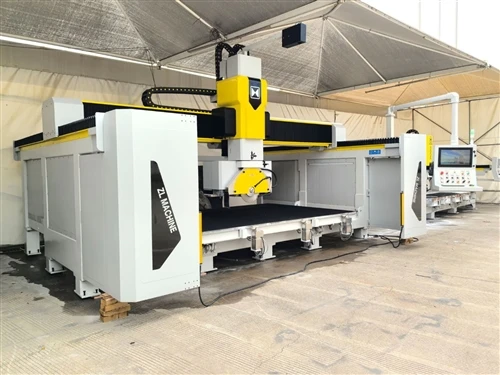
Hey there! If you're in the market for a CNC saw, you've probably come across the terms "3 Axis" and "5 Axis" and are scratching your head, wondering what the big difference is. Well, you're in the right place. As a supplier of 5 Axis CNC Saws, I've got the inside scoop on these bad boys, and I'm gonna break it down for you.
Basic Understanding of 3 Axis and 5 Axis CNC Saws
Let's start with the basics. A 3 Axis CNC saw operates along three linear axes: X (left - right), Y (forward - backward), and Z (up - down). It's like having a really precise robot that can move in these three directions to cut your material. It's a classic setup, and it's been around for a long time. You can use it for a wide range of simple to moderately complex cutting tasks. For instance, if you're cutting flat sheets of material into basic shapes like rectangles, squares, or circles, a 3 Axis CNC saw will do the job just fine.
On the other hand, a 5 Axis CNC saw takes things to a whole new level. In addition to the X, Y, and Z axes, it has two rotational axes. These rotational axes allow the cutting tool to tilt and rotate, giving it a much greater range of motion. This means you can cut complex 3D shapes with ease. Think of it as a super - flexible robot that can contort itself to get at any angle of your material.
Cutting Capabilities
Complexity of Shapes
The most significant difference between the two lies in the complexity of the shapes they can cut. A 3 Axis CNC saw is great for 2D and some simple 3D shapes. But when you start wanting to create intricate sculptures, contoured parts for automotive or aerospace industries, or custom - designed architectural elements, a 3 Axis saw will quickly hit its limits.


A 5 Axis saw, however, can handle all those complex geometries. It can cut undercuts, curves, and angles that would be impossible or extremely difficult with a 3 Axis saw. For example, if you want to create a decorative stone panel with a wavy, free - form design, a 5 Axis CNC saw can make it happen. You can check out some of the amazing things you can do with our Granite CNC Cutting Machinery which includes 5 Axis capabilities.
Precision and Accuracy
5 Axis CNC saws generally offer higher precision and accuracy when it comes to complex cuts. Because the cutting tool can be oriented exactly where it needs to be, there's less room for error. With a 3 Axis saw, you might have to re - position the material multiple times to achieve the same cut, which can introduce small inaccuracies each time you move it.
In a 5 Axis saw, the tool can approach the material from any angle, reducing the number of setups and improving the overall quality of the cut. This is especially important in industries where even the slightest deviation can lead to the part being unusable, like in medical device manufacturing.
Efficiency and Productivity
Setup Time
When it comes to setup time, 3 Axis saws are usually quicker to set up for simple jobs. Since they have fewer axes to configure, you can get them up and running faster. However, for complex jobs, the story is different. With a 3 Axis saw, you may need to spend a lot of time re - aligning the material and the cutting tool to achieve the desired shape.
A 5 Axis saw, while it may take a bit longer to set up initially for any job, can save you a ton of time in the long run for complex cuts. It can complete a multi - sided or curved part in one go, reducing the need for multiple setups and saving you valuable production time.
Material Utilization
5 Axis CNC saws are also better at material utilization. They can cut parts in a more efficient way, minimizing waste. Because they can access different angles of the material, they can fit more parts onto a single sheet or block. This is not only cost - effective but also more environmentally friendly. In contrast, a 3 Axis saw may not be able to use the material as efficiently, leading to more scrap.
Versatility
Range of Materials
Both 3 Axis and 5 Axis CNC saws can work with a variety of materials, including wood, plastic, metal, and stone. However, 5 Axis saws are more versatile in terms of the types of cuts they can make on different materials.
For example, in stone - cutting applications, a 5 Axis saw can create detailed and complex designs on granite, marble, or other hard stones. Take a look at our Bridge Stone Cutting Machine, which offers 5 Axis technology for precision stone cutting. It can produce everything from fireplace mantels to custom - designed bathroom vanities.
Cost Considerations
Initial Investment
The initial cost of a 5 Axis CNC saw is generally higher than that of a 3 Axis saw. This is because of the additional technology and components required for the two extra rotational axes. But it's important to look at the long - term value. If your business involves a lot of complex cutting jobs, the 5 Axis saw can pay for itself in terms of increased productivity, better quality, and reduced waste.
Operating Costs
Operating costs can also vary. A 3 Axis saw is usually simpler to operate and maintain, so its operating costs may be lower in the short term. However, a 5 Axis saw, despite having higher initial costs, can offset the difference in the long run by saving on material costs and increasing production speed.
When to Choose a 3 Axis or 5 Axis CNC Saw
If you're a small - scale operation that mainly does simple, 2D cutting jobs, like a hobbyist woodworker or a small sign - making shop, a 3 Axis CNC saw is probably your best bet. It's more affordable, easier to operate, and can handle your day - to - day needs.
But if you're in a high - end manufacturing industry, such as aerospace, automotive, or high - end architectural design, or if you want to expand your business to take on more complex projects, a 5 Axis CNC saw is the way to go. It can open up new opportunities and allow you to create products that are simply not possible with a 3 Axis saw. For example, our CNC Water Retaining Strip Cutting Machine with 5 Axis technology can produce high - precision water retaining strips for various applications.
Conclusion
In conclusion, the choice between a 3 Axis and 5 Axis CNC saw depends on your specific needs, budget, and the type of work you do. While a 3 Axis saw is a reliable and cost - effective option for simple jobs, a 5 Axis saw offers unparalleled flexibility, precision, and efficiency for complex cutting tasks.
If you're interested in learning more about our 5 Axis CNC Saws or have any questions about which saw is right for you, I'd love to chat. Don't hesitate to reach out and start a conversation. We can discuss your requirements in detail and see how we can help you take your business to the next level.
References
- "CNC Machining Handbook"
- Industry whitepapers on CNC saw technology