


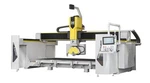
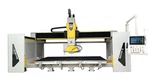
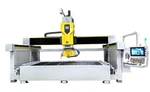
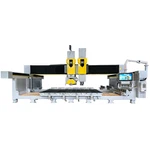


Granite Stone Cutting Machine Price For Sale

Granite Stone Cutting Machine Price For Sale

Granite Stone Cutting Machine Price For Sale

Granite Stone Cutting Machine Price For Sale

Granite Stone Cutting Machine Price For Sale

Granite Stone Cutting Machine Price For Sale

Granite Stone Cutting Machine Price For Sale
Granite Stone Cutting Machine Price For Sale
Linhai Zhongli Machinery Manufacturing Co., Ltd. is one of the most reliable manufacturers and suppliers of granite stone cutting machine price for sale in China. Welcome to buy TUV-certified granite stone cutting machine price for sale in stock here and get quotation from our factory. Quality products and reasonable price are available.

Products Parameter
|
Model |
5+1 Axis CNC bridge saw |
Unit |
|
Worktable size |
L3500*W2000 |
mm |
|
Maximum cutting |
L3500*W2000*H90 |
mm |
|
Maximum chamfering |
L3500*W2000*H60 |
mm |
|
Blade diameter |
350-425 |
mm |
|
Main motor power |
22 (permanet magnet motor with frequency) |
kw |
|
Router power |
5.5 |
kw |
|
Control center |
industry computer with CNC |
|
|
Controller brand |
own CNC system or ESA system from Italy |
|
|
Driving motor |
Servo motor |
|
|
Router max speed |
24000 |
RPM |
|
Total power |
35 |
kw |
|
Suction cup lifting weight |
200 |
kg |
|
Head rotate |
0°-360° |
|
|
Head tilt |
0°-90° |
|
|
Cylinders |
5 |
group |
|
Dimensions |
L5750*W3260*H3800 |
mm |
|
Water consumption |
2 |
m³/h |
|
Total weight |
5.4 |
t |
|
Main part delivered size |
5750x2200x2500 |
mm |
|
Machine-delivered method |
Main part delivered as a whole (HQ container) |
Quotation
Granite Stone Cutting Machine:
|
Option: (System)
1. Self-developed CNC System with "Cut Cam"software 2. ESA System from Italy |
Option: Chassis be hot-dip galvanized |
Option: Add front sliding doors |
Option: Worktable be faced with plastic plate and rubber |
Products Features

01
Electric spindle with 24000rpm
* Type: electric spindle
* Rotating speed: 0-24000 rpm
* Router Power: 5.5 kw
The rotating speed of this electric spindle is super higher. It makes fast & precise hole-drilling, engraving, curve cutting and corner cutting for Countertop, Kitchen Sink, etc.

02
A Camera to Locate the Position
This Machine equipt a high-precision camera to locate the position of the plate and display it in the cutting procedure

03
Worktable Turnover 85°
This worktable can be flipped over 85°

04
C-axis Rotate 0°~360°, A-axis Rotate 0°~90°
Head tilt 0°~90°, Head rotate 0°~360°

05
Four-Side Chamfering with Range 3500X 2000mm
This machine has excellent four-side chamfering function, with excellent chamfering range 3500x2000mm

06
17" Color Touch-Screen
This Machine has an industrial computer and a 17" color touch-screen.

07
CNC System and Built-in Library
The system has a built-in library of conventional-shaped drawings and also supports DXF format imports from designer or countertop measuring gauges.

08
Automatic Tool Setting Gauge
An automatic tool setting gauge is equipped that automatically checks the blade

09
A Group of Rotating Cylinders
A group of rotating cylinders on the side of the work table will automatically press the plate when the milling cutter works and automatically withdraw after the milling cutter works.

10
Suction Cup
The machine has Suction Cup to move slabs automatically.

11
22-KW Permanent Magnet Motor
The (5+1)A type with a 22-KW permanent magnet motor can be cut along with the thickness of the cutting plate, automatically adjusting the output power, strength, and power-saving environmental protection.

12
Functions:
* Straight Cut: various polygons, vertical Cut, inclined Cut, horizontal Cut, Chamfering
* Curve Cut: Curves, Waves,Circles, Ovals, and Maws.
* Stone Milling, Engraving, Profiling for making Inner angles, L-shaped countertops and four-sided under-hung countertops/Kitchen Sink/ Basin
* Vein Matching

Working Videos
Applications
1. Application Fileds:
* Residential & Commercial Interiors
* Decorative wall panels
* Countertops/ Vanity Top /Kitchen Sink/ Bathrooms
* Worktops
* Doorsteps, staircases and thresholds
* Fireplaces
* Flooring
* Funeral art
* Street furniture
* Ventilated facades
2. Application Pictures:


Factory Show
Our Factory was founded in 1993, and specializes in stone machine manufacture.
After more than 30 years' Development, we have become one of the most competitive enterprises in China. We have many Patents and have won the honors of "China Top Ten Enterprises (Stone Machinery)", "China AAA Grade Enterprise for Credit&Service (Stone Machinery)", "China Competitive Enterprises (Stone Machinery)", etc. And we have gained the quality certification of ISO9001, ISO2000, China Occupational Health and Safety, CE, etc.


Shipment
This model can be loaded into a 40' HIGH-CUBE Container.


Honour


Industry Information Sharing
- Classification of tectonic genesis of Granite:
Some modern granite theories contain a hypothesis that the formation of granite is related to orogeny and regional metamorphism. From this point of view, the traditional trough theory believes that granite with different characteristics can be formed at different stages of trough fold return or orogeny, and divides it into homoorogenic granite, late orogenic granite and post-orogenic granite, which is still used by some geologists today. Granite is mainly concentrated in orogenic belts, and the best reason for this relationship is that granite is a plutonic rock that can only be exposed to the surface by orogeny. After summarizing the research results of granite in the past 40 years, PitcherW.S. proposed a more reasonable tectonic classification of granite, namely the western Pacific type (island arc type), the Andes type (continental margin arc type), the Hercynian type (continental collision type), the Caledonian type (uplifted after collision) and the Nigerian type (main rift type). The basic geological characteristics of granite in various environments are also given [5]. However, Pitcher's classification is based on region-based generalization, and some types of selected areas are not representative, such as the Himalayan orogenic belt typical of land-land collisions, and some parts of the Hercynian belt in Europe formed by extensional action [3]. The main rift is only a stage in the process of crustal tension and thinning, and it may be more appropriate to use extensional as an environment; the various geological and geochemical characteristics of island arc granite with continental crustal basement are very similar to continental margin arc granite, which is difficult to distinguish, and it is more reasonable to classify them into one category (mature arc). The theory of crustal maturity is a new theory in the theory of tectonics, which is characterized by emphasizing the characteristics of material composition and evolution in different stages of the earth's crust in the process of tectonic evolution.
According to the theory of crustal maturity and referring to Pitcher's classification, the tectonic environment of granite is divided into the following types:
(1) Tension transitional crust granite (ECG), which is produced in the tensile environment of rift formation and continental disintegration, is formed due to the tensile thinning of the crust and the upwelling of hot materials in the upper mantle, which makes the crust form a high-temperature and low-pressure environment, and partially remelts the earth's crust, forming a large number of granite intrusions and condensation metamorphic rocks representing an extremely high geothermal gradient. At the same time, the thermal materials upwelling in the upper mantle are mixed with the hot materials of the earth's crust along the tensile fractures, and the materials of the continental crust are transformed into transitional types, forming granite of the tensile transition crust.
(2) Immature arc granite (IAG), which is a kind of extruded transitional crust granite, which is formed in the immature island arc, is mainly formed by basalt rocks in the process of a series of complex continental margin geological processes under subduction, through melting or metasomatism. This granite has many mantle source characteristics and its geochemical characteristics are similar to those of M-type granite.
and
(3) mature arc granite (MAG), which is another type of extruded transitional shell granite. It is mainly formed in two tectonic environments, the continental margin of the Andean type and the island arc containing the Precambrian massif. The geochemical characteristics of these two tectonic environments are between mantle and crust sources due to the fact that more crustal source material is involved in magmatic activity.
(4) Synorogenic granite (SOG), which is equivalent to the co-orogenic and late orogenic granite in the traditional classification. The more typical granites in the Himalayan belt are basically formed by the remelting of continental crustal materials, and their geochemical characteristics have the characteristics of continental crust.
(5) Post-orogenic granite (POG), a small intrusion formed by local magma chambers. It is important to note here that type A granite, the formation of which is generally thought to be related to the action of rifts. According to Xu Baoliang, Huang Fusheng et al., it is believed that there may be three tectonic environments for A-type granite, namely, slab margin (late orogenic period), transitional (after orogenic period), and intraplate (rift valley, rift-like valley) [6]. In fact, type A granite may have formed during the orogenic period and the re-opening of the continental massif, i.e., the early stage of the rifting process.
- Evolution Trend of Material Composition of Granite:
The geotectonic environment of granite formation is mainly determined by its tectonic location and the comprehensive geological characteristics of rock assemblage, sedimentary construction and metamorphism. On the other hand, in a certain tectonic environment, the material source, the degree of differentiation and metamorphism of granite are controlled by the tectonic environment, so it also has unique petrochemical characteristics, which can be used as a discriminant marker of the tectonic environment formed by granite, and provide a basis for the study of regional tectonic evolution.
In the early days of plate tectonic theory, the component polarity of island arcs was discovered, which is actually a reflection of the orderliness of elemental geochemistry in different stages of tectonic evolution. The different types of earth's crust are first and foremost manifested in their material composition. The oceanic crust is almost entirely composed of basalt rocks, and when the ocean floor expands to a certain extent, the subduction of the continental margin can form a series of mature and immature island arcs, but their material composition is quite different from that of the ocean or continent. The development of the primary granite layer from the immature arc to the plagioclase granite until the large-scale potassium feldsparization occurs is a basic law of the evolution from the oceanic crust to the extrusion transition crust to the continental crust. As we all know, the biggest difference between the continental crust and the oceanic crust is the thickness of the silicon-aluminum layer, because the thickness of the silicon-aluminum layer gradually increases from the ocean to the continent, the content of SiO₂ in granite also gradually increases, and the content of alkaline substances also gradually increases, especially the change of K₂O is more obvious. Whereas plate tectonics combines this change in K₂O content with the speed and depth of subduction, Peive A.B. combines the change in K₂O content with the maturity of the earth's crust, and considers the relative content of K₂O to Na₂O, i.e., the change in the ratio of K₂O/Na₂O, and concludes that this ratio increases with the evolution of oceanic crust to continental crust. On the contrary, the oxide content of Mg, Fe, Ca and other elements gradually decreased, reflecting the continuous transformation of the mantle-differentiated magma.
In terms of trace elements, Pearce J.A. et al. have done a lot of work and have given a distribution pattern of trace elements in a typical tectonic environment []. From Pearce's research, the following conclusions can be drawn, Pb, Be, Th, Ta, Nb and other large ionic lithophilic elements.
Although the abundance fluctuates somewhat, it basically increases from the ocean to the continent. However, the abundance of Hf, Zr, Y and other elements decreased slightly, which made the distribution curve of trace elements show an increasing slope from the ocean to the continent, and the Pb/Y ratio also increased. Another noteworthy is that granites with continental crustal properties (including rifts, co-collision periods, and post-collision periods) all have negative anomalies of Ba.Isotopes are often used as tracers for magma sources, especially Sr and Pb isotopes. It is believed that no isotope of any heavy element can be fractionated by the crystallization of magma. The initial composition of the Sr,Pb isotopes is singular throughout the chemically changing igneous series, but the change in the ratio of Sr,Pb isotopes is clearly related to lithology and has greater dispersion in the granite. From the ocean to the continent,Sr/⁸Sr and 206Pb/²04Pb have a gradual increasing trend, but in terms of specific values, it is necessary to refer to the results of other aspects to comprehensively study in order to obtain the actual situation of adapting to the work area. The study of rare earth elements in granite lags far behind that of basalt, and although some progress has been made, there is still no reliable conclusion.
Hot Tags: granite stone cutting machine price for sale, China granite stone cutting machine price for sale manufacturers, suppliers, factory, TUV-certified
You Might Also Like



Send Inquiry