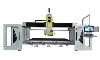

To ensure the assembly quality of bridge stone cutting machine products, it is necessary to operate in accordance with the specified assembly technical requirements for various stone machinery products.
Although the assembly technical requirements for different stone machinery products may vary, there are many key points in the assembly process that must be jointly observed in the contract.
1. Clean and clean the parts properly. The cleaning work includes removing residual casting sand, rust, chips, etc. Especially for some important components, such as the gantry cutting machine and the inner cavity, anti rust paint should be applied. Oil stains, rust, or attached chips on the parts can be cleaned with diesel, kerosene, or gasoline as a washing solution, and then dried with compressed air.
2. Before fitting or connecting, the matching surface usually needs to be lubricated. Especially in the bearing parts of the spindle box components and the screw nut parts of the lifting mechanism.
3. The matching dimensions of the matching parts should be accurate, and the matching dimensions should be rechecked or sampled during assembly. For example, the matching part of the main shaft journal and bearing, the matching hole of the main shaft box and bearing and its center distance.
4. The assembly of the wheel requires that the axis lines of the two gear wheels must be in the same plane and parallel to each other, ensuring normal gear clearance, and axial misalignment ≤ 2MM.
5. The joint surface of the connection should be checked for flatness and deformation, otherwise it should be trimmed and deburred to ensure that the joint surface is in close contact, flat, and not skewed.
6. The sealing element should be pressed parallel into the sealing groove and should not be twisted or deformed, damaged or scratched on the sealing surface.
7. The assembly requirement for the pulley is that the axes of the two pulleys must be parallel, and the center of the pulley groove should be aligned. Excessive deviation can cause uneven tension of the pulley, causing belt slippage and accelerated wear. At the same time, the triangular belt should be selected and matched before assembly, and the length should be consistent to prevent vibration during transmission.
8. Before assembling bearings, they should be cleaned and rust resistant paint should be removed before assembly; During cleaning, attention should be paid to checking the raceway and rolling body for rust and flexibility in rotation; When assembling bearings, a layer of lubricating oil should be applied to the surface of the mating parts. If a significant pressure difference is found during assembly, the assembly should be stopped for inspection; When assembling bearings, the end without model should be facing inward and against the shoulder of the shaft; When assembling bearings, the magnitude, direction, and position of the applied force should be appropriate, and the rolling element of the raceway should not be subjected to force. It should be evenly and symmetrically struck, and not violently struck, ensuring that the end face is perpendicular to the shaft and preventing installation tilting.
9. Thread connections should use anti loosening devices, and the following commonly used anti loosening devices should be selected according to the actual situation and design requirements; Double nut anti loosening; Spring washer anti loosening; Anti loosening of split pins; Lock washer anti loosening round nut and flower pad anti loosening; The symmetrical tightening method for multiple bolts should adopt a symmetrical sequence and gradually tighten, while the strip connectors should be tightened symmetrically and gradually from the middle to both directions. The tail of the ribbed bolt connection should protrude from the nut.
10. Ensure inspection while assembling.
11. Carefully carry out pre driving inspections. For example, checking the integrity of assembly work, the accuracy and reliability of various connecting parts, the flexibility of moving parts, and the normality of the lubrication system.
12. Carefully monitor the startup process. After starting the machine, immediately observe whether the main working parameters and moving parts move normally. The main working parameters include speed of movement, smoothness of movement, spindle rotation, lubricating oil pressure, temperature, vibration, and noise. Only when all motion indicators are normal and stable during the start-up phase can the test run be conducted.
13. Conduct trial operation and inspect relevant items according to the acceptance conditions of various stone machinery products. For example, adjusting and testing the cutting speed and stroke, adjusting the lifting motion stroke, and testing the spindle rotation accuracy.